SoftNAS® Surpasses Industry Standards with 40 Concurrent Replications

SoftNAS® Surpasses Industry Standards with 40 Concurrent Replications — Outperforming NetApp FSx and FSx for OpenZFS


HOUSTON, TEXAS – FOR IMMEDIATE RELEASE

SoftNAS® Surpasses Industry Standards with 40 Concurrent Replications.

Buurst announces next-generation replication scalability for enterprise cloud storage workloads, setting a new high-water mark in concurrent replication

HOUSTON, TX, UNITED STATES, July 30, 2025 /EINPresswire.com/ — Buurst™, a data performance company, today announced a significant replication performance breakthrough in its flagship software-defined NAS platform, SoftNAS. The latest version of SoftNAS now supports up to 40 concurrent replications, dramatically exceeding the current limits of Amazon FSx for NetApp ONTAP (12 concurrent replications) and FSx for OpenZFS (20).

“For enterprise customers managing dozens or even hundreds of replication jobs, SoftNAS removes traditional bottlenecks by scaling replication operations well beyond native file system limits,” said Andy Bowden, Head of Product and Marketing at Buurst. “Customers previously relying on scripts to run 10 replications at a time are now executing 4x as many jobs simultaneously — reducing replication windows, RPOs, and operational complexity.”

Experience in the Field: Built with Real Customer Workloads in Mind
The 40-replication benchmark was achieved during field testing with current customers in media and energy sectors — organizations with complex, distributed workloads that depend on efficient, resilient data synchronization between cloud regions, zones, and edge locations.
Customers leveraging SoftNAS for backup, DR, and high-availability scenarios have reported up to 75% faster synchronization cycles after enabling 40 concurrent replications. In real-world environments, this means completing what used to be an overnight replication job in just a few hours.
SoftNAS uses a combination of rsync-based and ZFS snapshot replication, combined with smart job scheduling and transport-level optimizations, to achieve this level of scalability — with no proprietary hardware or managed service lock-in.

SoftNAS continues to be the platform of choice for enterprises seeking granular control over their cloud storage architecture — especially those operating in regulated, high-availability, or edge-distributed environments. SoftNAS is used by Fortune 500 companies and public sector organizations that demand repeatable, deterministic replication workflows across their hybrid and cloud-native infrastructure. “We’ve architected SoftNAS to be fundamentally open and extensible — supporting enterprise scripting, custom replication schedules, and large-scale replication without the performance trade-offs of managed services,” said Bowden. “This is how we deliver enterprise resiliency without locking customers into vendor-defined limits.”

Get Started with 40x Replication Power Today
SoftNAS is available immediately via the AWS Marketplace, Azure Marketplace, and OCI Marketplace. Customers with existing scripted replication jobs can upgrade to take full advantage of the new 40-replication concurrency model.

About Buurst
Buurst, Inc. helps organizations optimize cloud performance, cost, and control through software-defined data solutions. Its flagship product, SoftNAS, enables secure, scalable file services and disaster recovery across major cloud platforms. Built on open technologies like ZFS and rsync, SoftNAS is trusted by customers in energy, media, government, and manufacturing.

Buurst Public Relations
Buurst, Inc
+ 13464100643

SoftNAS® is a registered trademark of Buurst, Inc. All other trademarks are property of their respective owners.


SoftNAS® Sets New Benchmark in High-Availability Cloud Storage

SoftNAS® Sets New Benchmark in High-Availability Enterprise Cloud Storage with Real-World Customer Results

HOUSTON, TEXAS – FOR IMMEDIATE RELEASE

Buurst Inc. announces enhanced SoftNAS capabilities that deliver 99.999% uptime and up to 40% cost savings across AWS, Azure, and Oracle Cloud.

HOUSTON, TX – [July XX, 2025] – Buurst™, a data performance company, today announced significant advancements in its flagship product, SoftNAS, delivering enterprise-grade cloud NAS with high availability, performance-based pricing, and cross-cloud flexibility. The enhancements have already demonstrated measurable impact during customer deployments across Oracle Cloud Infrastructure (OCI), AWS, and Microsoft Azure.

Organizations using SoftNAS are reporting up to 40% reduction in storage costs compared to capacity-based pricing models, while maintaining 99.999% uptime for mission-critical workloads. SoftNAS ensures uninterrupted operations through automatic failover across availability zones and built-in replication, making it a resilient, cost-effective alternative to native cloud storage solutions.

SoftNAS delivers block- and file-level storage through NFS, CIFS/SMB, and iSCSI protocols, with integrated replication, compression, and deduplication. What sets SoftNAS apart is its performance-based pricing model — customers pay for the throughput and IOPS they need, not the raw capacity they may never use.

Designed by Experts, Validated by Customers

Developed by a team of seasoned engineers with decades of experience in enterprise storage and cloud infrastructure, SoftNAS is engineered for demanding workloads — from media archives and backup repositories to retail analytics and edge databases.

“This is not just another cloud-native storage solution,” said Andy Bowden, Head of Product and Marketing at Buurst. “We built SoftNAS to solve the real challenges our customers face every day — like achieving HA across availability zones on Oracle, avoiding vendor lock-in, and simplifying multi-cloud DR strategies.”

Why SoftNAS Now?

✅ 99.999% Uptime Across HA Clusters — Validated through real-world deployments in Oracle and Azure environments.

✅ Up to 40% Cost Savings — Versus traditional per-capacity cloud storage models.

✅ Hybrid & Multi-Cloud Support — Deployable on AWS, Azure, OCI, and VMware.

✅ Full Protocol Support — Seamless integration via NFS, SMB, and iSCSI across Linux, Windows, and VMware.

Built for Trust and Transparency

SoftNAS includes secure VPC deployment, role-based access controls, and built-in snapshot recovery. All product enhancements are documented in real time through public changelogs, with patches released in coordination with industry vulnerability disclosures.

Buurst works closely with cloud vendors to maintain compliance and interoperability, and participates in regular security audits to meet the needs of government, healthcare, and regulated industries.

Get Started with SoftNAS Today

Engineers, IT leaders, and cloud architects can deploy SoftNAS in minutes via the AWS Marketplace, Azure Marketplace, or directly through the OCI Marketplace. A free 30-day trial and technical onboarding are available for qualified enterprise customers.

About Buurst

Buurst, Inc. is a data performance software company that helps organizations move, manage, and protect data in the cloud without compromising performance, security, or control. Its flagship product, SoftNAS, has been deployed globally across industries including energy, media, retail, and healthcare.

For more information, visit www.buurst.com.

Media Contact:
Buurst Public Relations

+1 (346) 410-0643
pr@buurst.com


SoftNAS® is a registered trademark of Buurst, Inc. All other trademarks are property of their respective owners.

SoftNAS 5 Webinar Recap on Upgrade Process

SoftNAS 5 Webinar Recap on Upgrade Process

To further promote the new SoftNAS 5 product release, Buurst’s engineering and support teams promoted a webinar to highlight new features and the unique upgrade process. As the underlying operating system for SoftNAS 5 was upgraded to CentOS 8.2, all existing SoftNAS users are required to follow a new process. This new process is discussed in the webinar along with a demonstration of the new tools available from support to simplify the upgrade. 

Previous SoftNAS 5 Release Content: 

If you have any questions on this upgrade process please find information HERE or email support@buurst.com. 

SoftNAS High-Performance SQL Storage

SoftNAS High-Performance SQL Storage

Many companies are moving SQL Server deployments to the cloud. If you are moving an app that is using SQL Server to the cloud, you will want to achieve the best performance possible, while keeping cost lowSoftNAS can be used in the cloud to optimize SQL performance and free up resources.  By reducing resource load on the SQL Server businesses will benefit with lower SQL licensing cost, and the reduce the cost associated with cloud storage.  

As a unified solution, SoftNAS provides an excellent base for Microsoft Windows Server deployments by providing iSCSI for Microsoft SQL Server, and network file system (NFS) or server message block (SMB) file storage for Microsoft Windows client access. This reduces complications for companies that are migrating from the data center to the cloud. While also enjoying the benefits of dedicated storage channels. 

Take advantage of high-performance storage by using SoftNAS and Microsoft SQL Server together. 

Protect your data and keep your SQL Server highly available while scaling up without limits.  

Microsoft SQL Server datastores consist of two fundamental data structure containers: data files and log files. Storing the data files and log files on separate disk drives distributes I/O activities. Backups should be stored in different storage located at a different availability zone. 

SoftNAS use the concept of a storage pool, which is a collection of storage and cache devices exclusively assigned to the pool. Storage is provisioned in shared file systems or block storage, and it is backed by intent-log and write-cache devices 

SoftNAS allow data on a disk to be compressed automatically and transparently to the application. Various levels of compression are available, with increasing performance impact as the data compression level increases. 

SoftNAS offers a broad range of instance sizes and region availability

It’s important to select the right instance size to configure a storage solution that is the right combination of performance and price for your use case. General guidance and a guide tool are provided to help you select an instance size for your workload to get your project started. Our instance size calculation tool is available directly on our main website: 

For extremely heavy workloads, increase cache memory with “High-Memory Instances” and/or use EBS-Optimized and Provisioned IOPS to provide better control over available IOPS. 

The above tool is designed to help new users find the right initial instance size for their workload quickly and easily. Buurst always recommends further analysis and testing of their selected instance until workload characteristics are fully understood. This will allow the customer to then refine their instance size selection to the perfect balance of performance and cost. 

Available Memory:

SoftNAS uses around 1 GB of RAM for the kernel and system operation. Memory beyond 1 GB is available for use as cache memory, which greatly improves overall system performance and response time – more memory = better performance, to a point. If application workloads involve a high number of small, random I/O requests, then cache memory will provide the best performance increase by reducing random disk I/O to a minimum. If running a SQL database application, cache memory will greatly improve query performance by keeping tables in memory. At a minimum, 2 GB of RAM will yield around 1 GB for cache. For best results, start with 4 GB or more RAM. With deduplication, add 1 GB of RAM per terabyte of deduplicated data (to keep deduplication look-up tables in RAM) 

CPU:

SoftNAS needs a minimum of 2 CPUs for normal operation. To maintain peak performance when using the Compression feature, add CPUs (e.g.,4 CPU) if CPU usage is observed at 60% or greater on average. 

Network:

In EC2, SoftNAS uses Elastic Block Storage (EBS), which are disks running across the network in a SAN (storage area network) configuration. This means all disk I/O travels across a shared network connecting the EC2 computing instance with the SAN. This makes network I/O an important factor in SoftNAS® environment performance. 

Multiple Performance & Scale Options:

EC2 offers Fixed Performance Instances (e.g. m3, c3, and r3) as well as Burstable Performance Instances (e.g. t2) for occasional heavy use over baseline. EC2 also offers many instance sizes and configurations. Consider all potential networking requirements when choosing instance type. Purchasing models include On-Demand, Reserved, and Spot Instances. 

For more information on deploying SoftNAS for High Performance SQL, see the deployment guide.

About SoftNAS Cloud NAS

Buurst SoftNAS is a hybrid cloud data integration product, combining a software-defined, enterprise-class NAS virtual storage appliance, backups, and data movement; and data integration/replication for IT to manage and control data centrally. Customers save time and money while increasing efficiency.

SoftNAS provides customers a unified, integrated way to aggregate, transform, accelerate, protect and store data and to easily create hybrid cloud solutions that bridge islands of data across SaaS, legacy systems, remote offices, factories, IoT, analytics, AI, and machine learning, web services, SQL, NoSQL and the cloud – any kind of data. SoftNAS works with the most popular public, private, hybrid, and premises-based virtual cloud operating systems, including Amazon Web Services, Microsoft Azure, and VMware vSphere.

SoftNAS storage solutions for SAP HANA

SoftNAS storage solutions for SAP HANA

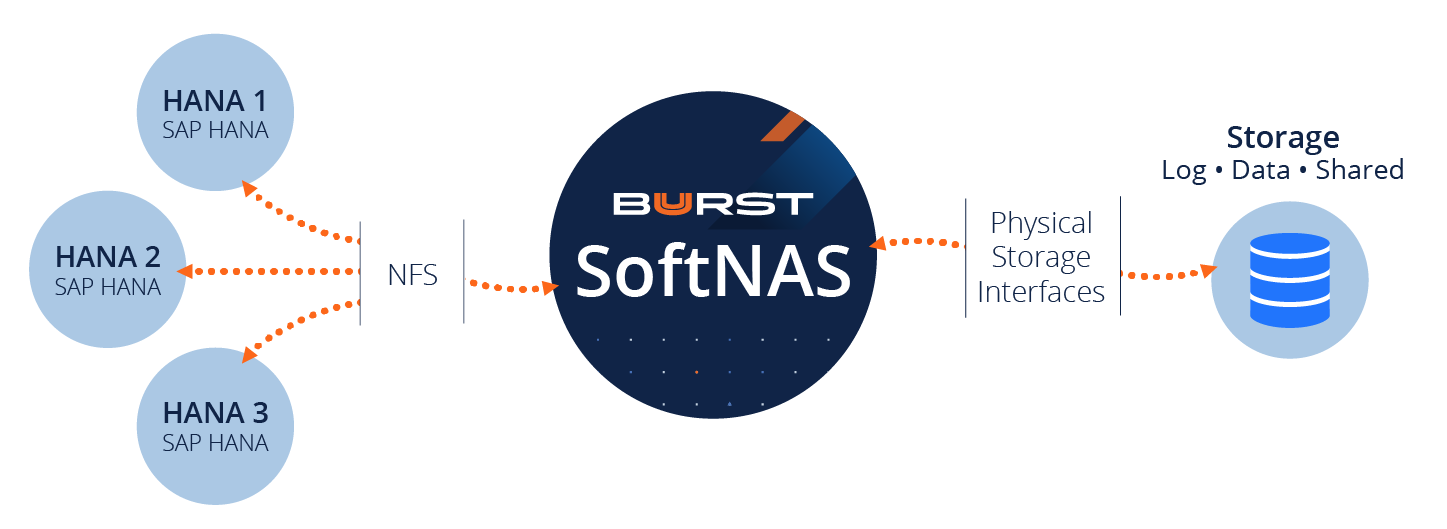
As we all know, one of the most critical parts of any system is storage. Buurst SoftNAS provides cloud storage performance to SAP HANA. This blog post will make it easier for you to understand the options available to SoftNAS and SAP HANA to improve data performance and reduce your environment’s complexity. You will also learn how to choose specific storage options for their SAP HANA environment.

SAP HANA is a platform for data analysis and business analytics. HANA can provide insights from your data—faster than traditional RDMS systems. Performance is essential for SAP HANA because it helps to provide information more quickly. SAP HANA is optimized to work with real-time data, so performance is a significant factor.

Top 5 reasons to choose Buurst SoftNAS SAP HANA

1. Superior performance for processing data
2. Maximum scale to process as much data as possible
3. High reliability
4. Low cost
5. Integration into existing infrastructure

All data and metadata for the SAP HANA system are in shared objects. These objects are copied from data tables to logical tables and accessed by SAP HANA software. So, as this information is grown, the impact on performance grows as well. By using SoftNAS to address performance bottlenecks, SoftNAS can accelerate operations that otherwise might be less efficient.

For example, the copy operation will undoubtedly be faster if you deploy storage with read-cache. Read cache is implemented with NVMe or SSD drives and helps copy the parameters from source tables to specialization indexes. Tables are frequently written, such as ETL operations, the technique of storing data and logs in SoftNAS reduces the complexity and resiliency, which reduces the overall risk for data loss. Cloud NAS can also improve your data requests’ response times and other critical factors like resource management and disaster recovery.

Storing your data and logs volumes on a NAS would certainly improve resilience. Using a NAS with RAID also allows for added redundancy if something goes wrong with one of your drives. Utilizing RAID will not only help to ensure your data is safe, but it will also allow you to maintain a predictable level of performance when it comes time to scale up your software.

Partitioning of data volumes allows for efficient data distribution and high availability. Partitioning will also help you scale up your SAP HANA performance, which can be a challenge with only one large storage pool. Partitioning will involve allocating more than one volume to each table and moving the information across volumes over time.

SAP HANA supports persistent memory for database tables. Persistent memory retains data in memory between server reboots. Loading data requires time to boot and load the data and then refresh the data. With SAP HANA deployed with SoftNAS storage, loading times are not a problem at all. The amount of data you consume will significantly benefit from persistence memory. While reading (basically accessing) records from persistent memory takes a long time, writing to the memory works much better with SoftNAS.

SoftNAS data snapshots enable SAP HANA backup multiple times a day without the overhead of file-based solutions, eliminating the need for lengthy consistency check times when backing up and dramatically reducing the time to restore the data. Schedule multiple backups a day with restore and recovery operations in a matter of minutes.

CPU and IO offloading help to support high-performance data processing. Reducing CPU and IO overhead effectively serves to increase database performance. By moving backup processes into the storage network, we can free up server resources to enable higher throughput and a lower Total Cost of Ownership (TCO).

You want to deploy SAP HANA because your business needs access to real-time information that allows you to make timely decisions with maximal value. SoftNAS is a cloud NAS that will enable you to develop real-time business applications, connecting your company with customers, partners, and employees in ways that you have never imagined before.